
Over the past several weeks, I have spent a fair amount of time in rooms with private equity investors, operating partners, enterprise technology leaders and founders building AI products.
The conversations are getting better.
A year ago, a lot of the discussion was still around what companies could do with generative AI. Now the questions are much more practical: Where is it actually producing value? Why are so many pilots not making it into production? Which use cases deserve more capital and management attention? And what has to be fixed before the AI is deployed?
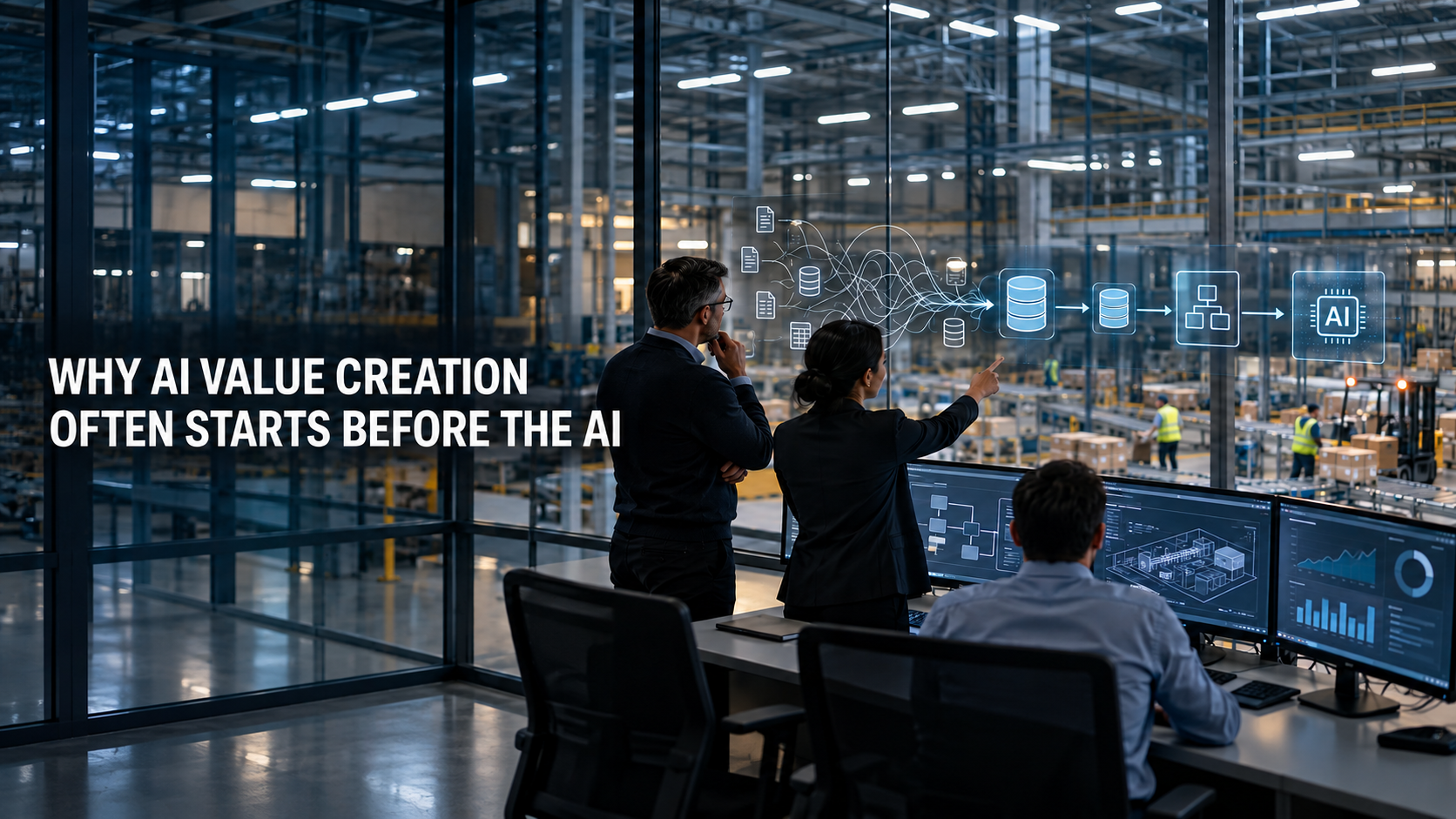
I was at another private equity breakfast in Houston this morning, and I came away with the same thought I have had repeatedly this year: for many mid-market companies, the AI problem starts well before the AI.
The underlying business environment often isn't ready for what management wants to put on top of it.
The demo is usually the easy part
Most enterprise AI demos today are impressive.
Give a model a defined set of data, a controlled workflow and a narrow objective, and it can produce a result very quickly. That creates understandable enthusiasm.
Production is different.
The customer data may be spread across three systems. The ERP may have been through two acquisitions and never fully integrated. Salespeople may have their own ways of entering information into the CRM. A finance process that looks standardized on paper may still depend on spreadsheets and institutional knowledge held by two employees.
Then there are permissions, cybersecurity, regulatory requirements and questions about what an AI agent should actually be allowed to do.
AI starts exposing problems that were already there.
This is one reason I think the experience many companies gained through ERP implementations, cloud migrations and SaaS integration over the past 15 or 20 years still matters. The technology has changed considerably. The enterprise realities around data, processes, ownership and change management have not disappeared.
BCG has found that more than half of companies it surveyed said legacy IT architectures were limiting AI scaling, reusability or data availability. That squares with what I am hearing directly from operators.
The more interesting examples start with a business problem
At a private equity event I attended last month, one firm shared several examples of AI being deployed across its portfolio.
Some of the results were substantial: more than 4,300 finance hours saved, a testing process reduced from roughly two months to a day, and dozens of internal GPT-style tools already in use.
What interested me was less the number of tools than what sat behind them.
There were defined use cases. There were internal champions. Training happened on a recurring basis. Governance and security were part of the deployment discussion. And there was an attempt to measure the result.
That is very different from giving every portfolio company a list of AI products and asking them to experiment.
I heard something similar at a recent mid-market operating conference. One healthcare example involved redesigning a medical billing workflow and using technology more intelligently within that process. Collections reportedly improved 25% to 30%, with some locations approaching 40%.
The lesson I took from that wasn't that every healthcare company needs the same technology.
It was that the value came from attacking a specific operating problem where the outcome could be measured.
That seems obvious, but plenty of AI projects still begin with the opposite question:
“Where can we use AI?”
For an operating partner, I think a more useful starting point is:
“Which operating bottleneck matters enough to solve, and what would have to change for us to solve it?”
AI may be part of the answer. Sometimes the first work is fixing the data, workflow or system underneath it.

Readiness matters as much as opportunity
This is especially important in private equity because time matters.
A five-year technology transformation that eventually produces an elegant architecture isn't particularly useful if the investment thesis requires visible operating improvement much sooner.
I would look at AI opportunities across two simple dimensions: potential value and readiness to execute.
High-value opportunities with high readiness should move quickly.
High-value opportunities with poor readiness are often where the more difficult work sits. The use case may be compelling, but the data needs cleaning, an ERP integration needs work, the process needs redesigning, or management ownership isn't clear yet.
Low-value experiments, even when technically easy, deserve much more skepticism.
That last category is becoming important because AI tools have become so inexpensive and easy to test. Companies can accumulate subscriptions very quickly without accumulating much economic value.
In a recent conversation with someone who runs private-equity operating-partner events around the country, he described hearing essentially the same issue. Larger firms are becoming more deliberate about tying AI investments to business cases, while some smaller organizations are still adding tools faster than they are rationalizing them.
That eventually becomes another technology-management problem.
McKinsey's 2025 State of AI survey provides some useful context. Almost nine in ten respondents said their organizations were using AI somewhere, yet nearly two-thirds had not begun scaling AI across the enterprise. Only 39% reported EBIT impact at the enterprise level.
Adoption is no longer the interesting metric. Value is.
Security and governance move upstream
The other change I have noticed in recent cybersecurity conversations is that governance is becoming part of the architecture discussion much earlier.
This becomes more important with agents.
A chatbot producing a questionable answer is one type of problem. An agent with access to CRM records, financial workflows, HR systems or customer data introduces a different set of questions.
What can it see?
What can it change?
Whose credentials is it using?
What happens when it takes the wrong action?
Can someone reconstruct what happened afterward?
For regulated companies, those questions become even more important. Waiting until deployment to solve them usually makes the project slower and more expensive.
This is why I increasingly see AI readiness as a combination of several things: business readiness, data readiness, technology readiness, security and governance, and management capacity to actually absorb the change.
The model is only one component.

PE has an interesting advantage here
Private equity firms may actually have an advantage in getting this right.
They can see patterns across multiple companies.
A workflow problem solved once in accounts receivable, customer support, software testing or sales operations can potentially inform similar work elsewhere in the portfolio. The underlying systems will differ, but the pattern recognition compounds.
The danger is assuming that the exact solution can simply be copied from one portfolio company into another.
I saw a version of this repeatedly at the venture conference I participated in last month. AI startups could often demonstrate something technically impressive very quickly. The harder diligence questions were much more mundane: How difficult is implementation? What systems does it integrate with? Who owns the data? What security controls exist? Can the customer prove ROI? What happens after the pilot?
Those are also the questions that matter when a PE-backed company buys the technology.
For me, that is where the next phase of AI value creation gets more interesting.
We have spent the last couple of years proving that the technology can do remarkable things. That question is largely settled.
The work now is figuring out where it belongs inside real businesses, what needs to change around it, and whether the resulting improvement is significant enough to matter during the hold period.
Sometimes the best AI decision will be to move quickly.
Sometimes it will be to fix the data or process first.
And sometimes it will be to stop an interesting experiment because the economics simply aren't there.
That discipline may end up being more important to value creation than the model companies choose.